
Solar & Battery Guides
kW vs kWh: how to read a home battery spec sheet
kW and kWh look alike on a battery quote but measure different things: how fast a battery can deliver energy, and how much energy it holds. This guide explains both, then walks through a real home battery datasheet line by line, from usable capacity and depth of discharge to peak power, efficiency, cycle life and IP rating.
Published 6 February 2026 · Facts last verified 7 October 2026
Quick answer: kWh (kilowatt-hours) measures energy: how much a battery stores. kW (kilowatts) measures power: how much it can supply at any moment. A battery with 16 kWh usable could run a steady 2 kW load for about eight hours, before losses, if its power rating allows it. On a spec sheet, read usable capacity in kWh for how long it lasts, and continuous and peak power in kW or kVA for how much it can run at once.
The kW vs kWh battery distinction matters because the two numbers limit different things. Capacity in kWh decides how far into the evening the battery carries your home. Power in kW decides how many appliances it can run at the same time. A large battery with a modest power rating can’t start every big appliance at once, and a powerful battery with little capacity runs flat early. A spec sheet gives you both, plus a dozen other lines that are easy to misread. We use the GoodWe ESA, a single-phase hybrid inverter on a stack of GoodWe battery modules, as the worked example.
kW vs kWh battery ratings: power and energy
Think of a water tank. Kilowatt-hours are the size of the tank; kilowatts are how far the tap can open. Energy is power multiplied by time: a 2 kW heater running for three hours uses 6 kWh, and a 100 W television left on for ten hours uses 1 kWh.
The Australian Government’s Your Home guide defines a battery’s capacity as how much energy it can store, usually measured in kWh. Power shows up in several places on the same sheet: how fast the battery charges, how fast it discharges, what the backup output can carry, and what it can surge to for a few seconds.
Backup and inverter ratings are often given in kVA (kilovolt-amperes) rather than kW. kVA is voltage multiplied by all the current an appliance draws, including current that does no useful work. For heaters and kettles kW and kVA are about the same; motors in fridges, pumps and air conditioners draw more kVA than their kW figure, and more again as they start.
Rated vs usable capacity, and depth of discharge
GoodWe’s GW8.3-BAT-D-G21 battery module shows why two capacity figures appear:
- Rated (nominal) capacity: 8.32 kWh. The total energy the module holds.
- Usable capacity: 8.0 kWh. What the battery lets you use. GoodWe’s footnote gives the test: 96% depth of discharge, cells cycled between 2.85 and 3.6 V, at a gentle 0.2P rate (roughly a five-hour charge and discharge) at 25 °C.
Depth of discharge (DoD) is the usable share as a percentage: 8.0 ÷ 8.32 is about 96%. Your Home says lithium batteries often have a DoD of 90–95%. Because usable capacity is measured under set lab conditions, treat it as a like-for-like comparison figure.
Compare batteries on usable capacity, because it is the energy you can draw on. It is also the figure the federal battery discount is calculated on, while eligibility is judged on nominal capacity, which has to be between 5 and 100 kWh; our federal battery rebate guide covers the program. How much usable capacity your home needs is a separate question, answered in what size home battery you need.
Continuous, peak and backup power
Power limits appear twice: once for the battery and once for the inverter it connects to. On the single-phase GoodWe ESA:
- Battery module: 8.0 kW in and out, and 12 kW for 10 seconds. GoodWe says its modules support 1C charging and discharging, which means a full charge or discharge in about an hour.
- Inverter battery port: up to 13.5 kW charging and 11.0 kW discharging.
- Backup output: 10 kVA continuous, and 20 kVA for 10 seconds to start motors.
Whichever limit in the chain is lowest is the one you get, so check both lines. GoodWe also footnotes that the module’s power figures derate with temperature and state of charge, so the headline numbers apply in good conditions.
Not every datasheet gives power. The FOXESS H1 G2 hybrid lists its battery port as 80–480 V and 40 A. Power is voltage times current, so the battery’s voltage decides how much of that port it can use. That is one reason battery voltage matters, as explained in high-voltage vs low-voltage home batteries.
Efficiency figures
Your Home defines round-trip efficiency as the efficiency of the battery including the inverter, and lists 92–96% as typical for lithium batteries. Datasheets more often give the efficiency of each conversion step instead:
- GoodWe ESA single-phase: maximum 97.5%, European 96.8%, battery-to-AC 97.8%.
- FOXESS H1 G2: maximum 97.08%, European 96.30%, solar-to-battery 98.5%, battery-to-AC 97.0%.
A maximum figure is the best single operating point. A European figure is a weighted average across part loads, so it is closer to everyday running. A round trip passes through more than one step, so it is always lower than any single figure on the sheet.
Cycle life and throughput warranties
A cycle is one full charge and discharge; two half discharges add up to one. GoodWe rates the GW8.3 module at 8,000 cycles or more, a figure based on test data under specific laboratory conditions. Your Home gives 1,000 to 10,000 cycles as the range for lithium batteries.
The warranty is the more useful number, because it is what the maker commits to. Battery warranties usually combine three limits and end at whichever comes first: a number of years, a minimum retained capacity and an energy throughput. GoodWe’s Australian warranty for the single-phase ESA runs 10 years and guarantees at least 70% of usable energy over that time or until a minimum throughput. To turn a throughput into cycles, divide it by the usable capacity: as an illustration, 30 MWh on a 10 kWh battery is 3,000 full cycles, a little over eight years at one cycle a day. We compare real terms in home battery warranties explained.
Temperature, IP rating and the rest of the sheet
- Operating temperature. The GW8.3-BAT-D-G21 charges between +2 °C and +55 °C and discharges from −20 °C to +55 °C; the G20 version has built-in heating and charges from −18 °C. The ESA inverter runs from −35 °C to +60 °C, derating above +40 °C.
- IP rating. Under IEC 60529 the first digit rates protection against dust and the second against water. GoodWe rates the ESA and its modules IP66 and FOXESS rates the H1 G2 IP65: both dust-tight, with the 6 tested against stronger water jets than the 5. GoodWe’s warranty still calls for a ventilated spot out of direct sunlight.
- Cell chemistry. LFP (lithium iron phosphate) on the GoodWe modules; see LFP batteries explained.
- Voltage. The battery’s operating window, 350–550 V on the single-phase ESA, which has to match the inverter.
- Weight and size. Each GW8.3 module weighs about 79 kg and measures 800 × 326 × 270 mm, which matters for where a stack can go.
Battery spec sheet glossary
| Term | What it means | Example (GoodWe ESA, single phase) |
|---|---|---|
| kWh | Energy stored or used | 8.0 kWh usable per module |
| kW | Power at a given moment | 11.0 kW maximum discharge |
| kVA | Apparent power, the usual unit for backup ratings | 10 kVA backup output |
| Rated (nominal) capacity | Total energy the battery holds | 8.32 kWh per module |
| Usable capacity | Energy you can draw on | 8.0 kWh per module |
| Depth of discharge | Usable capacity as a share of rated | About 96% |
| Peak power | A short surge above continuous power | 20 kVA for 10 s (backup) |
| 0.2P, 1C | Charge or discharge rate relative to capacity | Usable capacity tested at 0.2P |
| Round-trip efficiency | Energy out as a share of energy in, battery and inverter together | Not listed; conversion steps up to 97.8% |
| Cycle life | Full cycles under the maker’s test conditions | 8,000 or more |
| Throughput | Total energy the warranty covers | Set in the warranty |
| IP rating | Dust and water protection | IP66 |
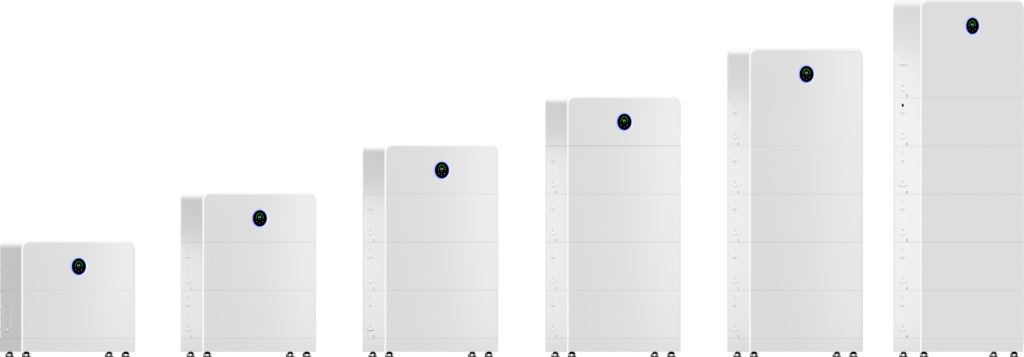
Our GoodWe ESA single-phase package with 16 kWh uses two of these modules and the GoodWe ESA single-phase package with 32 kWh uses four. To match the numbers to your usage, size a system for your home with Build Your System.
Frequently asked questions
What is the difference between kW and kWh on a battery?
kWh is how much energy a battery stores; kW is how much power it can deliver at any moment. A battery with 16 kWh usable and an 11 kW discharge limit could deliver 11 kW for under an hour and a half, or 2 kW for about eight hours, before losses. Capacity sets how long the battery lasts; power sets how much it can run at once.
What is the difference between usable and nominal capacity?
Nominal, or rated, capacity is the total energy a battery holds; usable capacity is the share you can actually draw on. GoodWe’s GW8.3 module is rated at 8.32 kWh with 8.0 kWh usable. Compare batteries on usable capacity: it is the energy available to your home, and the federal battery discount is calculated on it.
What does depth of discharge mean?
Depth of discharge (DoD) is usable capacity expressed as a percentage of total capacity. GoodWe’s GW8.3 module uses about 96% of its rated capacity (8.0 of 8.32 kWh), and the Australian Government’s Your Home guide says lithium batteries often run at 90–95%. A higher DoD means more of the battery’s capacity is available each cycle.
Why does a battery have a peak power rating?
Appliances with motors, such as fridges, pumps and air conditioners, draw a burst of power as they start. The peak rating covers that burst for a short time. The single-phase GoodWe ESA’s backup output is 10 kVA continuous and 20 kVA for 10 seconds; the FOXESS H1 G2’s is 5 kVA continuous and 6 kVA for 60 seconds.
What does a battery’s cycle life rating mean?
It is the number of full charge and discharge cycles the maker’s laboratory tests support, under its own test conditions. GoodWe rates its GW8.3 module at 8,000 cycles or more. In practice the warranty matters more, because its years, retained-capacity and throughput limits are what the maker actually guarantees.
Sources: GoodWe ESA single-phase and battery module datasheet (AU) · GoodWe — ESA single-phase product page · GoodWe limited warranty for the ESA (AU/NZ) · FOXESS H1 G2 datasheet (AU) · Your Home (Australian Government) — Batteries · Clean Energy Regulator — Cheaper Home Batteries Program
Every figure on this page is checked against its primary source before publication. If a datasheet, warranty or program changes, this page is updated and the verification date above moves with it.
Turn the spec sheet into a system
Build Your System asks about your solar, your phase, your bill and your backup needs, then recommends a battery and inverter sized to the answers, with indicative pricing.