
Solar & Battery Guides
Adding a battery to existing solar: AC coupling or a new hybrid
Most homes with solar panels can add a battery without starting again. There are two ways to do it: keep the inverter you have and add a battery system beside it on the AC side, or swap the old inverter for a hybrid that runs the panels and the battery together. Here is how each route works and how to choose between them.
Published 23 March 2026 · Facts last verified 7 October 2026
Quick answer: there are two ways to add a battery to existing solar. AC coupling keeps your current inverter and adds a hybrid inverter and battery beside it, with a sensor reading the old inverter’s output. Replacing the old inverter with a hybrid moves your panels onto the new unit, so one inverter runs everything. Your inverter’s age, your roof, your supply phase, network limits and whether you want backup decide which suits you.
If you want to add a battery to existing solar, the first decision is what happens to the inverter already on your wall. Build Your System starts in the same place: its first question is whether you already have solar, and your answer tells it whether you are adding a battery to an existing system or installing solar and a battery together. From there, the choice between keeping your inverter and replacing it depends more on that inverter than on the battery.
Add battery to existing solar: the two routes
Solar panels make direct current (DC). Your inverter turns it into alternating current (AC) for the house and the grid. A battery stores DC, so the question is where the battery meets your solar.
- AC coupling. The old inverter keeps doing its job. A new hybrid inverter, connected at the switchboard, measures what the house and the old system are doing, takes the surplus and stores it in the battery. Your existing panels never connect to the battery directly.
- A new hybrid (DC coupling). The old inverter comes off the wall and the panels are rewired to a hybrid inverter, which charges the battery straight from the panels and supplies the house from both.
Either way you end up with a hybrid inverter and a battery. If the term is new, our guide to what a hybrid inverter does covers the basics. The difference between the routes is whether your old inverter stays.
Route 1: AC coupling keeps your inverter
FOXESS hybrids are set up for this. The H1 G2 manual says Australian units ship with two current transformers (CTs), clamp-on sensors that measure the power flowing in a cable: CT1 is for the hybrid itself and CT2 is for an existing grid-tied inverter, if there is one. The KH manual assigns its second CT the same way. With both readings, the hybrid knows what your old system is producing and what the house is using, so it can charge the battery from surplus solar instead of exporting it.
AC coupling makes the most sense when:
- Your inverter is fairly new, working well and still under warranty.
- The roof is full, so moving panels gains nothing.
- You want more solar later. The hybrid has its own solar inputs, so new panels can go straight onto it: with a battery, the 5 kW H1 G2 takes up to 10 kW of panels, within your network’s limits.
Weigh three things. There are two inverters on the wall to look after. Energy from the old system is converted from DC to AC, back to DC to charge the battery, then to AC again when you use it, and each conversion loses a little; for panels wired straight to the H1 G2, FOXESS quotes 98.5% solar-to-battery efficiency, a shorter path the old array can’t take. And in a blackout the old inverter shuts down like any grid-connected solar inverter, so in a typical AC-coupled layout the backed-up circuit runs on the battery and any panels connected to the hybrid, not on your existing array.
Route 2: a new hybrid takes over the panels
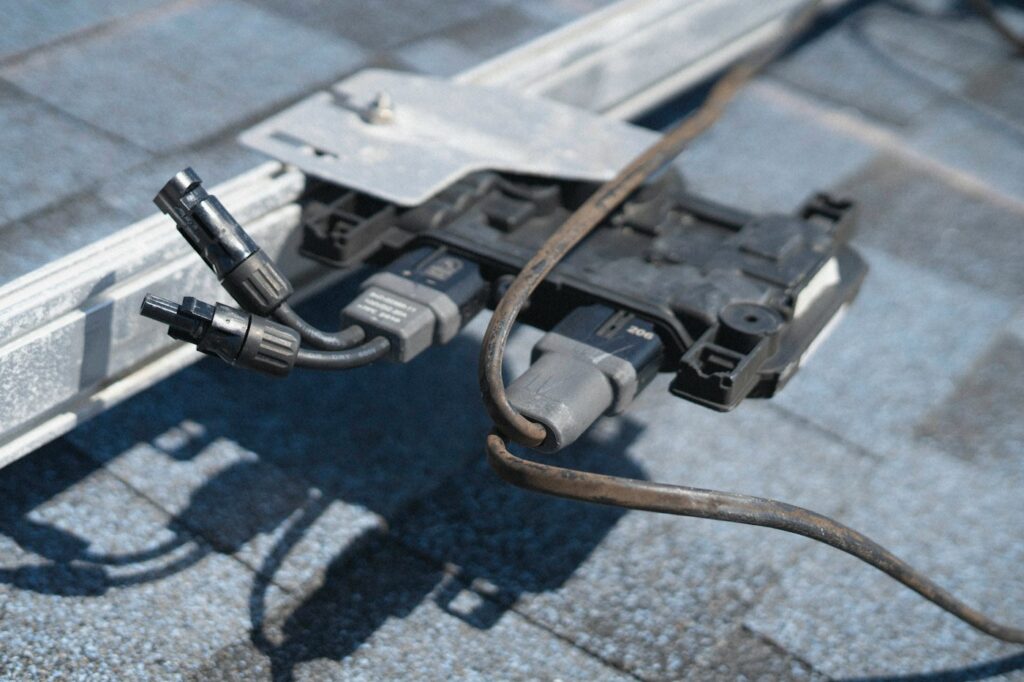
Here the old inverter is removed and your existing panels are rewired to the hybrid’s solar inputs, its MPPTs. One inverter then runs the panels, the battery and the house.
- Old or failing inverters. If yours is out of warranty or showing faults, replacing it now avoids keeping a second inverter going.
- Small arrays you want to grow. With a battery, hybrids accept far more panels than their AC rating: up to 10 kW on the FOXESS H1 G2, 16 kW on the KH8 and 20 kW on the KH9.9, and 20 kW of solar input across four MPPTs on the GoodWe ESA single phase.
- Backup that uses all your solar. FOXESS’s H1 G2 and KH manuals say that when the grid is off, the system supplies emergency power from the panels or the battery, so every panel on the hybrid can help during an outage. The GoodWe ESA single phase adds whole-home backup through a built-in 63 A bypass.
Your existing panels have to suit the new inverter’s inputs. Each MPPT has voltage and current limits (on the H1 G2, up to 600 V and 16 A per input), and new panels are best kept on their own input rather than mixed into an old string. The installer checks this on site. In Victoria, a replacement inverter also has to meet the emergency backstop rules that have applied to new systems and inverter replacements since 1 October 2024: a compatible inverter with a reliable internet connection, unless an exception applies.
Which route suits your home?
Use this as a first pass; the site assessment confirms it.
| Your situation | Keep the inverter (AC coupling) | Replace it (new hybrid) |
|---|---|---|
| Inverter age and warranty | Fairly new, reliable, warranty still running | Old, out of warranty or faulty |
| Panels and roof | Roof is full, or new panels can go on the hybrid | Small array you want to grow on one inverter |
| Supply phase | The added hybrid must suit your supply and the network’s per-phase limits | A chance to choose a three-phase hybrid if your home has three-phase power |
| Network capacity | Both inverters count towards your approved capacity | One inverter keeps the total lower |
| Backup in a blackout | The battery and any panels on the hybrid; the old array stops | The battery, plus the panels where the hybrid runs solar in backup |
| Switchboard and wall space | Room for a second inverter, the battery and their protection | The new inverter can take the old one’s place |
Network approval and export limits
Adding a battery changes your connection, so your distributor (CitiPower, Powercor, United Energy, Jemena or AusNet) has to approve it. Networks look at inverters, not panels: AusNet, for example, sizes systems on the combined rating of all solar and battery inverters and sends anything over 10 kW per phase to a manual assessment. Keep a 5 kW solar inverter and add a 5 kW hybrid, and the application shows 10 kW.
A battery doesn’t raise your export limit either. United Energy’s standard limit is 5 kW on single- and two-phase connections and 15 kW on three-phase, and constrained areas can be lower. What changes is how much of your solar you keep: surplus that would have been exported or curtailed goes into the battery instead. The application is lodged before installation, usually by the installer, and the export limit the network approves is set in the inverter.
Can you get the battery discount with existing solar?
Yes. The Clean Energy Regulator says batteries under the Cheaper Home Batteries Program can be installed with a new or existing solar system of 100 kW or less. The discount is calculated on the battery’s usable capacity. The battery must be on the Clean Energy Council’s approved list and able to join a virtual power plant, and the installer must be accredited by Solar Accreditation Australia. Amounts change over time, so we keep them out of guides like this one: see solar and battery rebates in Victoria and our federal battery rebate guide.
Our systems for homes that already have solar
Our FOXESS packages can go in as a new system or as an AC-coupled retrofit beside an existing inverter. The FOXESS H1 G2 5 kW package suits most single-phase homes keeping their inverter, and the FOXESS KH8 8 kW package adds three solar inputs and room for up to 16 kW of panels. Where replacing the inverter makes more sense, the GoodWe ESA 9.99 kW single-phase package takes up to 20 kW of panels on four inputs and backs up the whole home. Before choosing, check what size inverter you need; a site assessment then confirms your inverter, roof, switchboard and network rules.
Frequently asked questions
Can I add a battery without replacing my solar inverter?
Yes. With AC coupling, your existing inverter stays and a hybrid inverter with a battery is installed beside it. A current sensor on the old inverter’s output tells the hybrid how much solar you are making, so it can store the surplus. This suits newer inverters with warranty left. If your inverter is old or failing, replacing it with a hybrid is usually the better long-term choice.
Will my existing solar charge the battery during a blackout?
Not in a typical AC-coupled system. Like any grid-connected solar inverter, the old one switches off when the grid fails, so the backed-up circuit runs on the battery and on any panels wired to the new hybrid. If solar during outages matters to you, moving the panels onto a hybrid that uses solar in backup mode lets all of them keep working.
Do I need my distributor’s approval to add a battery?
Yes. A battery adds inverter capacity to your connection, so your distributor approves the change before it is installed. In Victoria that is CitiPower, Powercor, United Energy, Jemena or AusNet, depending on your address. Networks assess the combined rating of all inverters on the site, and your approved export limit stays in place: a battery doesn’t increase it.
Can I get the federal battery discount if I already have solar?
Yes. The Clean Energy Regulator allows batteries to be installed with new or existing solar systems of 100 kW or less. The battery must be on the Clean Energy Council’s approved list and able to join a virtual power plant, and an installer accredited by Solar Accreditation Australia must install it. The discount is calculated on the battery’s usable capacity.
Sources: FOXESS H1/AC1 G2 user manual (AU) · FOXESS KH user manual · FOXESS H1 G2 datasheet (AU) · FOXESS KH datasheet (AU) · GoodWe ESA single-phase datasheet (AU) · AusNet — connections up to 30 kW · United Energy — solar connection process · Victorian Government — emergency backstop mechanism for solar · Clean Energy Regulator — Cheaper Home Batteries Program · Clean Energy Council — approved batteries
Every figure on this page is checked against its primary source before publication. If a rule, a datasheet or a program changes, this page is updated and the verification date above moves with it.
Add storage to the solar you already have
Tell Build Your System you already have solar, answer three more questions and see a battery system sized to your home, with indicative pricing. We confirm the best route at a site assessment.