
Solar & Battery Guides
What size inverter do you need? 5, 8, 10 or 15 kW
The inverter decides how many panels your system can carry, how much of your house the battery can run at once and how much stays on in a blackout. Here is how to size one for a Victorian home, with every hybrid inverter we install side by side.
Published 30 April 2026 · Facts last verified 7 October 2026
Quick answer: size the inverter to your roof, your supply phase and your biggest loads. On single-phase power, a 5 kW hybrid suits up to 10 kW of panels and moderate evening use; an 8 to 10 kW hybrid suits 16 to 20 kW of panels, heavier evenings and stronger backup. Three-phase homes can go to 15 kW. A bigger inverter won’t raise your export limit, which is usually 5 kW on single phase.
What size inverter do I need? It is a different question from how big the battery should be, which we cover in what size home battery you need. The battery sets how many kilowatt-hours (kWh) you can store. The inverter, rated in kilowatts (kW), sets how much power can flow at once: in from the panels, out to the house and into a backup circuit. Get it wrong and you either pay for capacity you can’t use or send power to the grid that your home could have used.
What size inverter do I need for my home?
Six things decide it, roughly in this order:
- Your roof. How many panels fit, and across how many roof faces.
- Your supply phase. Single-phase homes choose from 5 to 10 kW in our range; three-phase homes from 5 to 15 kW.
- Network limits. Your distributor caps exports and assesses the total inverter capacity on the site.
- Your evening and daytime loads. The inverter’s AC rating is the most your solar and battery together can supply to the house at any moment.
- Backup. The backup output grows with the inverter.
- What’s coming. An EV, electric heating or more panels later.
The inverters we install, side by side
Every inverter in our packages is a hybrid inverter: it runs panels and a battery together. The panel limits below are the manufacturers’ maximums with a battery in the system.
| Inverter | Supply | AC output | Most panels | MPPTs | Backup output |
|---|---|---|---|---|---|
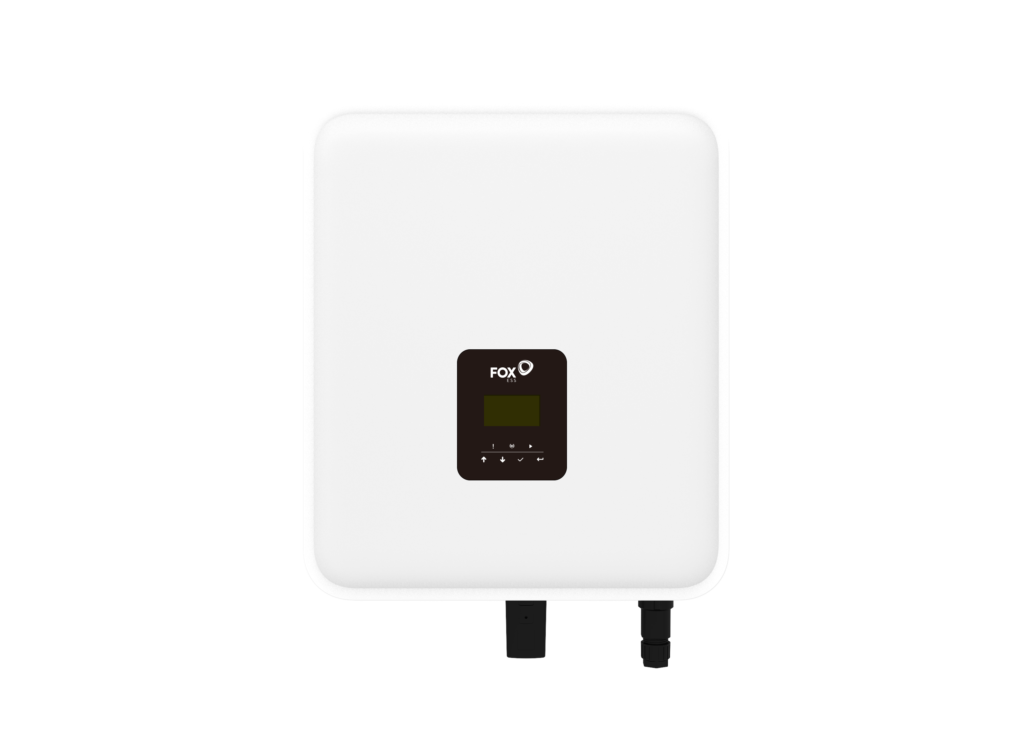
| FOXESS H1-5.0-E-G2 | Single phase | 5 kW | 10 kWp | 2 | 5 kVA |
| FOXESS KH8 | Single phase | 8 kW | 16 kWp | 3 | 8 kVA |
| FOXESS KH9.9 | Single phase | 9.9 kW | 20 kWp | 4 | 9.9 kVA |
| GoodWe ESA GW9.999K-EHA-G20 | Single phase | 9.999 kW | 20 kW of solar input | 4 | 10 kVA |
| FOXESS H3-5.0-Smart | Three phase | 5 kW | 11 kWp | 3 | 5 kW |
| FOXESS H3-9.9-Smart | Three phase | 9.9 kW | 20 kWp | 3 | 10 kW |
| FOXESS H3-15.0-Smart | Three phase | 15 kW | 30 kWp | 3 | 15 kW |
| GoodWe ESA GW9.999K-ETA-G20 | Three phase | 9.999 kW | 20 kW of solar input | 4 | 10 kVA |
| GoodWe ESA GW15K-ETA-G20 | Three phase | 15 kW | 30 kW of solar input | 4 | 15 kVA |
MPPTs are the independent solar inputs, and panels on different roof faces each want their own. Our guide to MPPTs and how many you need explains why the count can matter as much as the kW.
Start with the roof: how many panels can each size carry?
Without a battery, the guidelines accredited installers work to cap the panels at about 133% of the inverter’s AC rating, because the inverter must be at least 75% of the array. That is where the familiar 6.6 kW of panels on a 5 kW inverter comes from. With a battery, the limit becomes the manufacturer’s, which is about double the AC rating on our hybrids; solar panel oversizing explained sets out the rules. In practice:
- Up to about 10 kW of panels on one or two roof faces: a 5 kW hybrid such as the FOXESS H1 G2.
- About 10 to 16 kW, or three roof faces: the 8 kW FOXESS KH8.
- Up to 20 kW, or four roof faces: the FOXESS KH9.9 or the GoodWe ESA, both with four inputs.
- Beyond 20 kW: three-phase supply and a 15 kW inverter, which takes up to 30 kW of panels.
These are ceilings, not targets. Shading and each input’s voltage and current limits decide what fits, and we design inside them.
Single or three phase?
Your supply sets the menu. Single-phase homes in our range choose between the 5 kW H1 G2, the 8 kW KH8, the 9.9 kW KH9.9 and the 9.999 kW GoodWe ESA. Three-phase homes choose between the FOXESS H3 Smart at 5, 9.9 or 15 kW and the GoodWe ESA at 9.999 or 15 kW. Networks also assess capacity phase by phase: AusNet, for example, sizes systems on the combined rating of all solar and battery inverters and sends anything over 10 kW per phase to a manual assessment. If you’re not sure which supply you have, single phase vs three phase shows how to check.
Why a bigger inverter doesn’t export more
Your distributor, not your inverter, sets how much you can send to the grid. United Energy’s standard export limit is 5 kW on single- and two-phase connections and 15 kW on three-phase connections. Victoria’s other distributors, CitiPower, Powercor, Jemena and AusNet, set comparable limits, and constrained areas can be lower. A 10 kW inverter on a single-phase home is still held to the approved limit. The extra size pays off in what you keep: more panels feeding the house and the battery, and more power available to the house at once.
5 kW vs 10 kW inverter: what changes?
Most single-phase decisions come down to this comparison:
| 5 kW: FOXESS H1 G2 | About 10 kW: FOXESS KH9.9 or GoodWe ESA | |
|---|---|---|
| Most panels, with a battery | 10 kWp | 20 kWp (20 kW of solar input on the ESA) |
| Solar inputs | 2 | 4 |
| Most it can supply to the house at once | 5 kW | 9.9 to 9.999 kW |
| Backup output | 5 kVA (6 kVA for 60 seconds) | 9.9 kVA on the KH9.9; 10 kVA on the ESA (20 kVA for 10 seconds) |
| Export on a standard single-phase connection | Usually 5 kW | Usually 5 kW |
| Suits | Modest roofs, moderate evenings, essential-circuit backup | Large roofs on several faces, heavy evenings, EV charging, whole-home backup |
The third row is the one people miss. An inverter can only supply its AC rating. If your evening load often runs above 5 kW, from ducted air conditioning and cooking at the same time for example, a 5 kW hybrid supplies 5 kW from the battery and the grid supplies the rest, even when the battery is full. The same ceiling applies to the backup output in a blackout. If your evenings are moderate and you only want key circuits backed up, 5 kW is often enough. A large roof, heavy evenings, an EV or whole-home backup point to 8 to 10 kW.
Matching an inverter to your home
Our packages pair each inverter with a battery, so the panels can be sized past 133% where your roof and usage justify it. Common starting points are the FOXESS H1 G2 5 kW package for modest single-phase roofs, the FOXESS KH8 8 kW package for bigger ones, the GoodWe ESA 9.99 kW single-phase package for four roof faces and whole-home backup, and the FOXESS H3 Smart 15 kW three-phase package for large three-phase homes. If you already know the size you want, Build Your System lets you pick the inverter and battery directly; if not, its four questions recommend a system with a smaller and a larger option beside it. Panels and mounting are quoted after a site assessment.
Frequently asked questions
What size inverter do I need for a 6.6 kW solar system?
A 5 kW inverter. Without a battery, the guidelines installers work to allow panels up to about 133% of the inverter’s AC rating, so 6.6 kW of panels on a 5 kW inverter is the standard pairing. With a battery and a hybrid such as the FOXESS H1 G2, the same 5 kW inverter can take up to 10 kW of panels, leaving room to add more later.
Can a single-phase home have a 10 kW inverter?
Often, yes, subject to your distributor’s approval. Single-phase hybrids of about 10 kW, such as the FOXESS KH9.9 and the GoodWe ESA single phase, suit larger homes. Networks assess the total inverter capacity on the site, and exports are usually still limited to 5 kW. The larger inverter earns its keep through a bigger array, heavier evening loads and stronger backup, not through exports.
Does a bigger inverter need a bigger battery?
Not necessarily. Inverter size is about power, in kW: how much can flow at once. Battery size is about energy, in kWh: how much is stored. A 5 kW inverter can sit in front of a large battery and simply discharge it at up to 5 kW. Size the battery on your evening and overnight use, and the inverter on your roof, phase and peak loads.
Should I size the inverter for an EV I plan to buy?
It is worth planning for. An EV is a large load, and if you charge it at home during the day, a bigger inverter and array let more of that charging come from your own solar. If the EV is some way off, plan the roof layout and inverter with it in mind now, and confirm the size at your site assessment.
Sources: FOXESS H1 G2 datasheet (AU) · FOXESS KH datasheet (AU) · FOXESS H3 Smart datasheet (AU) · GoodWe ESA single-phase datasheet (AU) · GoodWe ESA three-phase datasheet (AU) · Clean Energy Council — Guidelines for grid-connected solar PV systems (no storage), version 14 · SolarQuotes — the battery exception to the 133% limit (secondary) · United Energy — solar connection process · AusNet — connections up to 30 kW
Every figure on this page is checked against its primary source before publication. If a rule or a datasheet changes, this page is updated and the verification date above moves with it.
Find the inverter size that fits
Build Your System asks whether you have solar, your phase, your bill and your backup needs, then recommends an inverter and battery sized to the answers, with indicative pricing.