
Solar & Battery Guides
What is an MPPT, and how many do you need?
An MPPT is the part of a solar inverter that keeps a string of panels working at its most productive voltage as sunlight and temperature change. How many MPPTs an inverter has decides how many roof faces it can handle well. Here is how tracking works, what the current and voltage limits on a datasheet mean, and how to work out how many you need.
Published 19 February 2026 · Facts last verified 7 October 2026
Quick answer: MPPT stands for maximum power point tracking: electronics in the inverter that keep adjusting the voltage of a string of panels so it delivers the most power as sun and temperature change. On the inverters covered here, each MPPT takes one string, so the rule of thumb is one MPPT for each roof face with panels: one or two for a single north face, two for east–west, and three or four for a more complex roof.
What is MPPT doing from minute to minute? A solar panel doesn’t have one fixed output. Its current and voltage trade off along a curve, and one point on that curve, the maximum power point, gives the most power. That point moves as clouds pass, the sun swings across the sky and the panels heat up. The tracker’s job is to keep finding it, all day, for every string it controls.
What is MPPT (maximum power point tracking)?
PVEducation, the solar-cell reference written by Christiana Honsberg and Stuart Bowden, describes a cell’s power curve as having a single maximum, the maximum power point, at a particular voltage and current. Light and heat both move it. Brighter light raises the current. Heat lowers each silicon cell’s open-circuit voltage by about 2.2 mV per degree, and the power with it: a 505 W Trina Vertex S+ panel, for example, loses 0.29% of its power for every degree its cells run above 25 °C.
An MPPT is a DC converter at the front of the inverter that keeps adjusting the operating voltage it presents to the string and settles wherever the power peaks. Think of a cyclist changing gears to stay at the cadence where they are strongest. Without tracking, a string would sit at a fixed voltage and lose power whenever the conditions moved the peak.
Why each roof face needs its own MPPT
Panels in a string are wired in series, so the same current flows through all of them. As PVEducation explains, the overall current from a series combination cannot exceed that of the poorest cell. Panels facing east and west produce different currents for most of the day, so in one string the weaker side holds back the stronger.
Give each face its own MPPT and each string finds its own maximum power point: the east face peaks in the morning, the west face in the afternoon, and neither drags on the other. The inverters compared below all take one string per MPPT, so a large single face can also be split across two MPPTs with no mismatch penalty.
Shading works the same way. A shaded panel limits its string’s current until its bypass diodes, fitted across groups of cells, route current around the shaded section. That changes the shape of the power curve, and the tracker has to find the new best point.
Reading the MPPT limits on a datasheet
Each MPPT has a window the string has to fit, in both current and voltage:
- Maximum input current. In a series string the current is one panel’s current. A 505 W Trina Vertex S+ runs at about 15 A at its maximum power point, which fits under the 16 A limit on the FOXESS H1 G2 and KH with little to spare, and comfortably under 20 A on the FOXESS H3 Smart and GoodWe ESA. Above the limit, the inverter caps the current and the extra is lost.
- Short-circuit current. A separate safety ceiling that the panels’ short-circuit current must stay below: 20 A per MPPT on the H1 G2, 25 A on the H3 Smart and 26 A on the ESA.
- MPPT voltage range. The string’s operating voltage must sit inside it: 80–550 V on the H1 G2, 80–500 V on the KH series, 120–950 V on the H3 Smart and 40–560 V on the ESA. Very short strings can fall below it: two 500 W-class panels at about 33 V each give only about 66 V, under the FOXESS single-phase floor but inside the ESA’s.
- Maximum input voltage. The absolute ceiling: 600 V on the H1 G2, KH and ESA, and 1,000 V on the H3 Smart. Panel voltage rises as temperature falls, so strings are sized for the coldest morning, not a mild noon.
- Power per MPPT. Some datasheets cap it: 3,750 W per MPPT on the H1 G2 and 10,000 W on the H3 Smart.
Your installer works these limits out from the panel datasheet and the site’s lowest temperatures; these are the numbers behind that calculation.
MPPT counts across our range
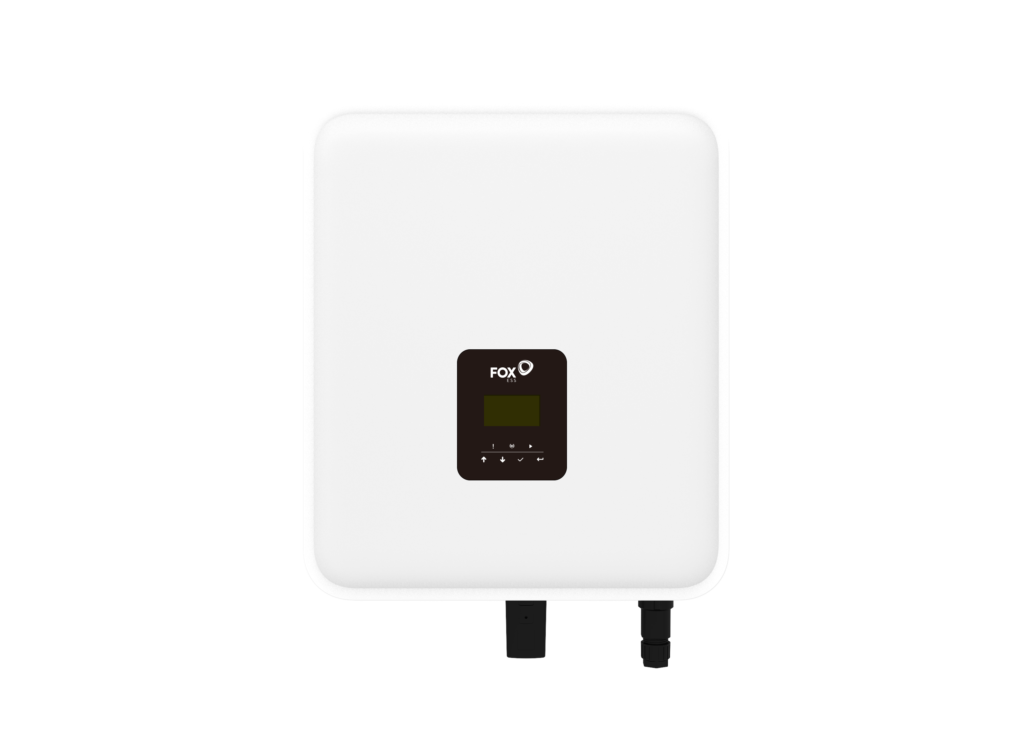
| Inverter | Supply | MPPTs | Current per MPPT | MPPT voltage range | Maximum input voltage | Maximum solar |
|---|---|---|---|---|---|---|
| FOXESS H1-5.0-E-G2 | Single phase | 2 | 16 A | 80–550 V | 600 V | 10 kWp |
| FOXESS KH8 | Single phase | 3 | 16 A | 80–500 V | 600 V | 16 kWp |
| FOXESS KH9.9 | Single phase | 4 | 16 A | 80–500 V | 600 V | 20 kWp |
| GoodWe ESA GW9.999K-EHA-G20 | Single phase | 4 | 20 A | 40–560 V | 600 V | 20 kW input |
| FOXESS H3 Smart (5, 9.9, 15 kW) | Three phase | 3 | 20 A | 120–950 V | 1,000 V | 11, 20 or 30 kWp |
All of them take one string per MPPT. The H3 Smart needs three-phase supply; whether you have it, and what it changes, is covered in single phase vs three phase solar.
How many MPPTs do you need?
Start with your roof, not the inverter:
- Count the faces you will use. Each orientation and pitch is a face, and so is a section with its own shading pattern.
- Give each face its own MPPT. One north face needs one MPPT, or two if the array is big enough to split. East–west needs two. Three or four faces need three or four.
- Check each string against the window. Enough panels to clear the minimum voltage, few enough to stay under the maximum on a cold morning, and current within the limit.
- Match the inverter. Two MPPTs on the H1 G2, three on the KH8 and H3 Smart, four on the KH9.9 and the GoodWe ESA.
With more faces than MPPTs, the usual options are to leave the weakest face empty, combine faces only where orientation and pitch match, or step up to an inverter with more inputs. The FOXESS KH9.9 package and the 9.99 kW single-phase GoodWe ESA with 16 kWh both have four MPPTs, and the ESA’s take 20 A each. MPPT count is one input to inverter size, alongside array size and phase: see what size inverter you need and solar panel oversizing explained.
Build Your System asks about your existing solar, phase, bill and backup, and NRGPAL confirms the roof faces and string design at the site assessment. To see which inverter fits, size a system for your home.
Optimisers and microinverters
Two technologies move tracking down to each panel:
- Optimisers are small DC converters fitted behind each panel. Each tracks its own panel’s maximum power point and feeds a string inverter, so one shaded panel no longer drags the rest.
- Microinverters convert each panel’s output to AC on the roof. The US Department of Energy notes that with microinverters, shading or damage to one panel doesn’t affect the power drawn from the others. Because their output is AC, a battery added later connects AC-coupled, through its own inverter.
Both put more electronics on the roof. On an unshaded roof with a few large faces, an inverter with one MPPT per face usually covers it and keeps the electronics at ground level; a hybrid inverter also keeps solar-to-battery charging on the DC side, as explained in what is a hybrid inverter.
Frequently asked questions
What does MPPT stand for?
MPPT stands for maximum power point tracking. It is the circuit in a solar or hybrid inverter that keeps adjusting the operating voltage of a string of panels so the string delivers its maximum power as sunlight and temperature change. Each MPPT tracks one input, which is why inverter datasheets list how many they have.
How many MPPTs do I need?
As a rule of thumb, one for each roof face that will carry panels, because panels facing different ways produce different currents and hold each other back in a shared string. A single north-facing array needs one or two, an east–west roof two, and a roof with three or four usable faces three or four.
How many panels can go on one MPPT?
It depends on the panels’ voltage and current and on the MPPT’s limits. On the FOXESS and GoodWe inverters compared above, each MPPT takes one string, whose voltage must sit inside the tracking range (80–550 V on the FOXESS H1 G2, for example) and stay under the maximum input voltage on the coldest morning. The installer calculates it from the panel datasheet.
Is more MPPTs always better?
No. An MPPT only helps if there is a string to put on it, so a single unshaded north-facing array gains little from four inputs. Extra MPPTs earn their place on roofs with several faces, partial shade on one face, or panels of different models that shouldn’t share a string.
Do MPPTs fix shading?
Partly. Separate MPPTs stop a shaded face from dragging down the others, but within a string a shaded panel still limits the current until its bypass diodes route around it. Where shade falls on a few panels for much of the day, per-panel optimisers or microinverters can recover more of the lost output.
Sources: FOXESS H1 G2 datasheet (AU) · FOXESS KH datasheet (AU) · FOXESS H3 Smart datasheet (AU) · GoodWe ESA single-phase datasheet (AU) · Trina Solar Vertex S+ NEG18R.28 datasheet (AU) · PVEducation — IV curve and maximum power point · PVEducation — effect of temperature · PVEducation — mismatch in series · PVEducation — bypass diodes · US Department of Energy — Inverters and grid services basics
Every figure on this page is checked against its primary source before publication. If a datasheet changes, this page is updated and the verification date above moves with it.
Match the inverter to your roof
Build Your System asks about your solar, your phase, your bill and your backup needs, then recommends an inverter and battery sized to the answers, with indicative pricing. We confirm the roof faces on site.