
Solar & Battery Guides
High-voltage vs low-voltage home batteries
Home batteries come in two broad designs: low-voltage batteries that run at around 48 V, and high-voltage batteries that run at hundreds of volts. The difference changes how much current flows, how heavy the cabling is, which inverters a battery works with and how it is installed. Here is how they compare, using the battery voltage windows of the inverters we install.
Published 17 March 2026 · Facts last verified 7 October 2026
Quick answer: a high-voltage home battery runs at hundreds of volts (350–550 V on the single-phase GoodWe ESA); a low-voltage battery runs at about 48 V. For the same power, the high-voltage battery carries a fraction of the current, so cables are lighter and losses lower, and it suits the battery port of a modern hybrid inverter. Low-voltage batteries suit small and off-grid systems. Either way, the battery must sit inside the inverter’s battery voltage window.
The high voltage vs low voltage battery question comes down to current. Power is voltage multiplied by current, so a battery at about seven times the voltage needs about one-seventh of the current to deliver the same power. Less current means lighter cables, less heat in the connections and smaller losses. It is also why every hybrid inverter we install is built for high-voltage batteries, and none of them accepts a 48 V one.
High voltage vs low voltage battery: side by side
| Low-voltage battery | High-voltage battery | |
|---|---|---|
| Typical voltage | 48 V class (51.2 V nominal for 16 LFP cells) | Hundreds of volts (350–550 V on the single-phase GoodWe ESA) |
| Current for 5 kW | About 98 A at 51.2 V | About 13 A at 380 V |
| Resistive loss in the same cable | About 55 times higher | The baseline |
| Cabling | Heavy cables and busbars | Lighter cables |
| Adding capacity | More batteries in parallel | More modules in the stack, within the system’s limits |
| Inverters | Inverter-chargers built for 48 V | Hybrid inverters with high-voltage battery ports |
| AS/NZS 5139 voltage class | Usually within class A (up to 60 V DC) | Above class A, with stricter cable protection |
| Typical use | Small and off-grid systems | Grid-connected home systems |
Why voltage matters: current, cables and losses
Current is power divided by voltage. Sixteen LFP cells at about 3.2 V each make the common 51.2 V “48 V” battery; at that voltage, 5 kW takes about 98 A. A battery at the single-phase ESA’s 380 V nominal delivers the same 5 kW at about 13 A.
GoodWe’s datasheet shows the high-voltage side in practice: the single-phase ESA’s battery port handles 13.5 kW of charging at 35.6 A and 11.0 kW of discharging at 29.0 A. A 51.2 V battery delivering the same 11 kW would need about 215 A.
Heat in a cable rises with the square of the current. At about 7.4 times the current, the same cable produces about 55 times the heat, so low-voltage systems need much heavier cables, busbars and fuses to keep losses and temperatures in check.
Voltage also sets how much power a current-limited battery port can pass. The FOXESS H1 G2’s battery port is limited to 40 A, and the KH series to 50 A. At 40 A, a 200 V battery can move at most 8 kW and a 400 V battery 16 kW, before the inverter’s other limits apply. How to read those lines on a datasheet is covered in kW vs kWh: how to read a home battery spec sheet.
How high-voltage batteries stack modules
Many high-voltage batteries connect their modules in series, so the voltages add: as an example, four modules of about 50 V make about 200 V and eight make about 400 V. Capacity grows in module-sized steps, and the inverter’s battery window sets how many modules a stack can have: too few won’t reach its minimum voltage, and too many will exceed its maximum.
GoodWe’s ESA works differently. Its datasheet gives the GW8.3 module an operating voltage range of 350–550 V in a single-phase system, the same window as the inverter’s battery port, and the stacks we install, from two modules to six, all run within it. The same module is listed at 700–950 V in a three-phase system, GoodWe’s three-phase ESA, which the Clean Energy Council approved in February 2026. GoodWe also lets 5 kWh and 8 kWh modules, and old and new ones, share a stack, with up to six modules in a single column.
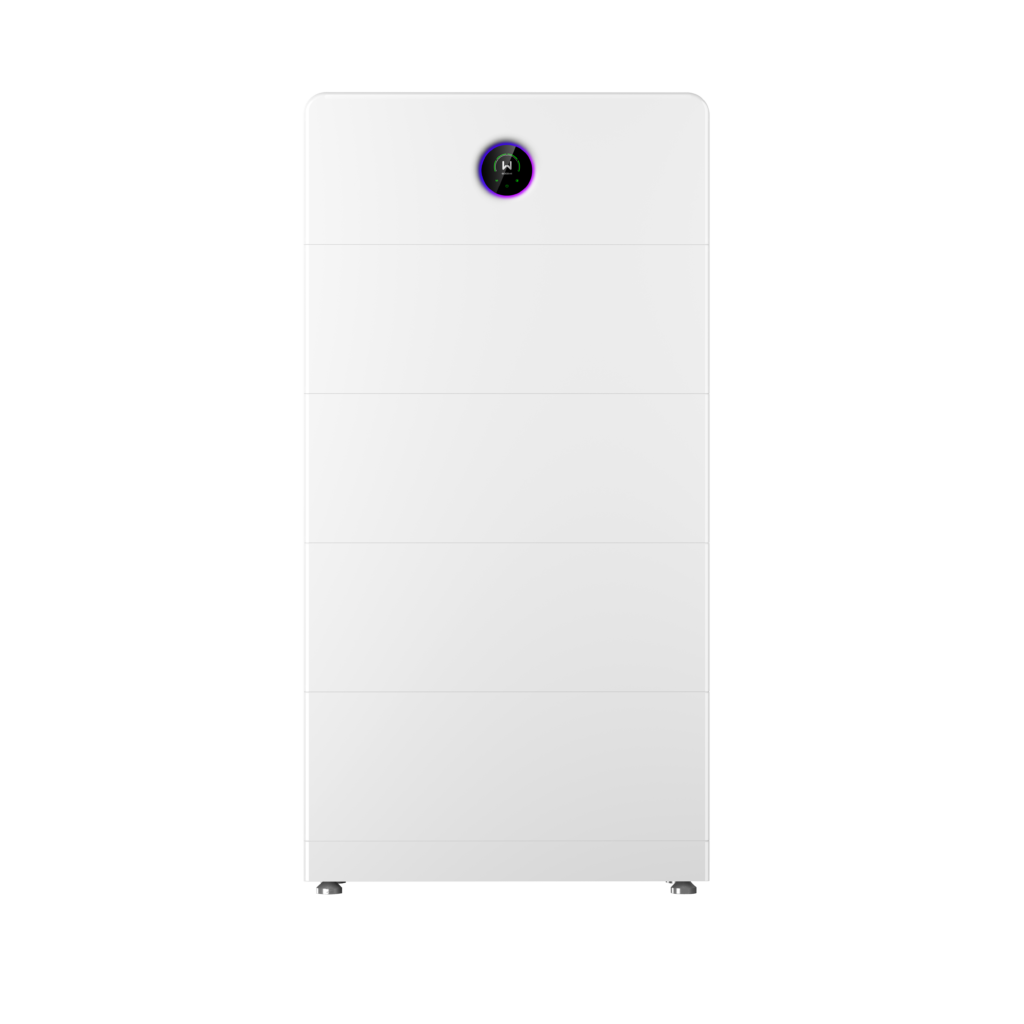
Low-voltage batteries grow the other way. Extra batteries connect in parallel, so the voltage stays at about 48 V while the capacity and current capability add up.
Will a battery work with your inverter?
Voltage compatibility is a hard limit: the battery’s whole operating range has to sit inside the inverter’s battery window.
| Inverter | Supply | Battery voltage window | Battery current limit |
|---|---|---|---|
| FOXESS H1-5.0-E-G2 | Single phase | 80–480 V | 40 A |
| FOXESS KH8 and KH9.9 | Single phase | 85–480 V (300 V recommended) | 50 A |
| FOXESS H3 Smart (5, 9.9 and 15 kW) | Three phase | 100–800 V | Varies by model |
| GoodWe GW9.999K-EHA-G20 (ESA) | Single phase | 350–550 V (380 V nominal) | 35.6 A charging, 29.0 A discharging |
None of these accepts a 48 V battery. Voltage isn’t the only test, either: the inverter and the battery’s management system have to communicate, so in practice the battery must be one the inverter’s maker supports. On the ESA the question doesn’t arise, because the hybrid inverter and the battery are one product; see what is a hybrid inverter. If you are adding a battery to an existing system, the same check applies to whichever inverter will run it, as covered in adding a battery to existing solar.
Are high-voltage batteries safe?
Several hundred volts of DC demands respect, and the installation rules reflect it. Under AS/NZS 5139, the Australian standard for battery installations, a pre-assembled battery system above decisive voltage class A (more than 60 V DC) must have its cables mechanically protected all the way to the inverter. Solar Victoria’s technical guidance, reviewed by Energy Safe Victoria, shows this as medium-duty conduit between battery and inverter. The work has to be done by a licensed electrician.
Low voltage lowers the shock risk but not every risk. A 48 V battery delivering the same power pushes far more current through its terminals and cables, and a loose high-current connection gets hot. Whatever the voltage, the cell chemistry and battery management carry much of the safety load; see why home batteries use LFP.
When does a low-voltage battery still make sense?
Low-voltage batteries remain common in small and off-grid systems: a shed, a holiday shack, a caravan or an off-grid home built around a 48 V inverter-charger. They are added to in parallel, and at around 48 V they normally sit in the lowest voltage class for installation. The Australian Government’s Your Home guide notes that DC-coupled systems have long been popular off the grid, including in caravans, boats and huts.
For a grid-connected home with solar, the hybrid inverters we install are built for high voltage. Our GoodWe systems run from the 9.99 kW single-phase GoodWe ESA with 16 kWh to the single-phase GoodWe ESA with 48 kWh. To see which suits your home, size a system for your home.
Frequently asked questions
What voltage is a high-voltage home battery?
There is no single figure, but high-voltage home batteries run at hundreds of volts. The single-phase GoodWe ESA’s battery side runs at 350–550 V (380 V nominal), and FOXESS hybrids accept batteries from 80–480 V (H1 G2), 85–480 V (KH series) or 100–800 V (H3 Smart). A low-voltage battery, by contrast, runs at about 48 V.
Can I connect a 48 V battery to a hybrid inverter?
Only to a hybrid designed for low-voltage batteries. None of the hybrids we install accepts one: their battery inputs start at 80 V on the FOXESS H1 G2, 85 V on the KH series, 100 V on the H3 Smart and 350 V on the GoodWe ESA. The battery must also be one the inverter’s maker supports.
Are high-voltage batteries more efficient?
For the same power they carry far less current, and resistive heating rises with the square of the current, so cable and connection losses are lower. Overall efficiency still depends on the inverter and the battery, so compare the battery-to-AC efficiency on each datasheet: GoodWe rates the single-phase ESA at up to 97.8%.
Is a high-voltage battery safe in a home?
Installed to the rules, yes. AS/NZS 5139 sets stricter requirements for battery systems above 60 V DC, including mechanical protection for the cables all the way to the inverter, and the work must be done by a licensed electrician. A stable chemistry such as LFP and the battery management system add further layers of protection.
Can I add modules to a high-voltage battery later?
Usually, within the maker’s limits. On series-connected stacks the inverter’s voltage window caps the module count. GoodWe’s ESA allows up to six modules in a single column and lets 5 kWh and 8 kWh modules, and old and new ones, share a stack. Check module versions and current rebate rules before you plan on it.
Sources: GoodWe ESA single-phase and battery module datasheet (AU) · GoodWe ESA three-phase datasheet (AU) · GoodWe — CEC approval for the three-phase ESA · GoodWe — ESA single-phase product page · FOXESS H1 G2 datasheet (AU) · FOXESS KH datasheet (AU) · FOXESS H3 Smart datasheet (AU) · Solar Victoria — Technical guidance sheet 2.3: battery system wiring systems · Your Home (Australian Government) — Batteries · Battery University — types of lithium-ion (secondary)
Every figure on this page is checked against its primary source before publication. If a datasheet or a standard changes, this page is updated and the verification date above moves with it.
Get a battery that fits your inverter
Build Your System asks about your solar, your phase, your bill and your backup needs, then recommends a matched battery and inverter, with indicative pricing.