
Product Guides
Australian-made solar panels: the Tindo Walara 475 W
Tindo Solar builds its panels at Mawson Lakes, north of Adelaide, and describes itself as Australia’s only solar panel manufacturer. Here is what “Australian made” means for a panel, what the Walara 475 W datasheet says, how it compares with imported TOPCon panels and who it suits.
Published 4 August 2026 · Facts last verified 7 October 2026
Quick answer: Australian made solar panels are panels whose last substantial manufacturing step happens in Australia; under the ACCC’s guidance, imported components can still be used. Tindo Solar makes its Walara range at Mawson Lakes in South Australia. The Walara 475 W is an all-black N-type TOPCon panel with 21.9% efficiency and 25-year product and performance warranties. Expect to pay more per watt than for comparable imported panels.
If you want Australian made solar panels, the field is small. Tindo Solar describes itself as Australia’s only solar panel manufacturer, and its current Walara range comes in 440 W and 475 W versions. This guide looks at the 475 W, an all-black panel, and at the reasons to choose it or not.
What does “Australian made” mean for a solar panel?
A solar panel is an assembly: cells, glass, encapsulant, a backsheet or rear glass, an aluminium frame and a junction box. An origin claim describes where the panel is made, not where every part comes from.
The ACCC’s guidance on country-of-origin claims says “made in” means the last substantial step in making the product happened in that country, a step that makes the finished product fundamentally different from its imported components. Imported components are allowed. A “product of” claim is stricter: the main components come from that country and almost all the processing happens there.
Tindo’s datasheet says the Walara is “Manufactured in Australia by Tindo Operations Co Pty Ltd”, and designed and engineered by a team based in South Australia. The factory is at Mawson Lakes, in Technology Park, about 12 km north of the Adelaide CBD. Tindo was founded in 2011 and directly employs around 70 people. If it matters to you where the cells themselves are made, ask, because a “made in Australia” claim doesn’t require them to be local.
Tindo Walara 475 W: what the datasheet says
Tindo calls the Walara G4P its ninth generation of panel. The 475 W model, Walara-475G4P-BL, uses N-type TOPCon cells, the mainstream cell technology we explain in N-type TOPCon solar panels explained.
| Specification | Tindo Walara 475 W (Walara-475G4P-BL) |
|---|---|
| Rated power | 475 W, tolerance 0 to +5 W |
| Cells | 120 half-cut N-type TOPCon cells, 16 busbars |
| Module efficiency | 21.9% |
| Dimensions | 1910 × 1133 × 35 mm |
| Weight | 23.5 kg |
| Front glass | 3.2 mm fully tempered, double anti-reflective coating |
| Frame | Anodised aluminium alloy (T6), black |
| Junction box | IP68, three bypass diodes |
| Temperature coefficient (Pmax) | −0.30%/°C |
| Maximum system voltage | 1,500 V DC |
| Mechanical load | 5,400 Pa front, 2,400 Pa rear |
| Certification | IEC 61215, IEC 61730 |
| Product warranty | 25 years |
| Performance warranty | 25 years, 87.4% of rated power at the end |
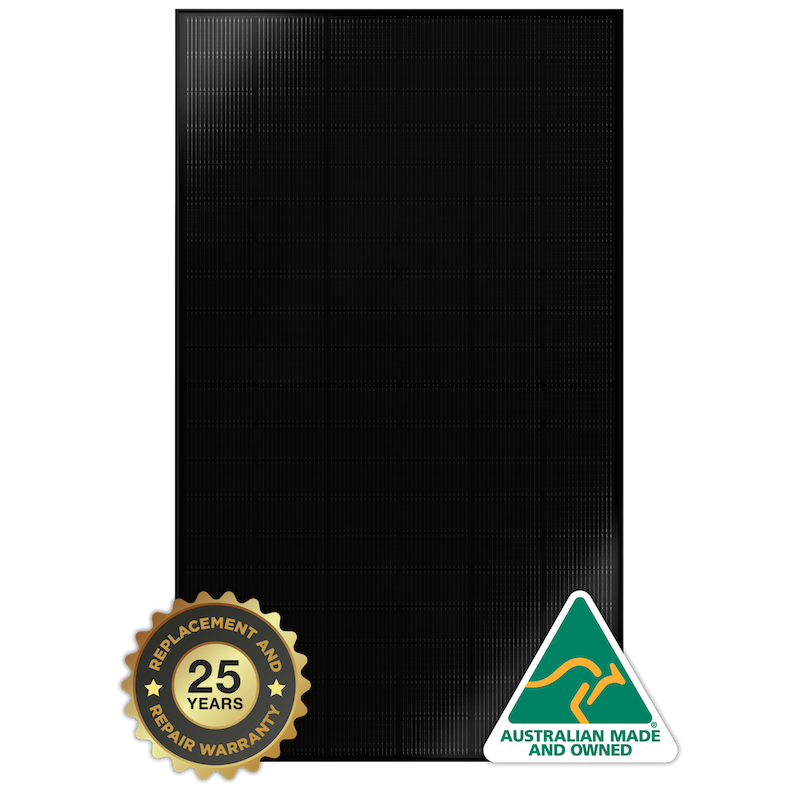
Two lines are worth reading closely. The temperature coefficient of −0.30%/°C is in line with other TOPCon panels, so the Walara loses about as much output on a hot roof as its imported rivals. The performance warranty guarantees 87.4% of rated power after 25 years; the Trina and Suntech TOPCon panels in our comparison guarantee the same 87.4% after 30 years. The datasheet describes the cells as bifacial but gives no rear-side rating, and it specifies the front glass but not the rear.
How does it compare with imported TOPCon panels?
| Tindo Walara 475 W | Trina Vertex S+ 505 W | Suntech Ultra V Pro mini 440 W | |
|---|---|---|---|
| Made | Mawson Lakes, South Australia | Imported | Imported |
| Efficiency | 21.9% | 22.7% | 22.5% |
| Temperature coefficient (Pmax) | −0.30%/°C | −0.29%/°C | −0.29%/°C |
| Size | 1910 × 1133 mm | 1961 × 1134 mm | 1722 × 1134 mm |
| Glass | 3.2 mm front (rear not specified) | 1.6 mm front and back | 1.6 mm front and back |
| Performance warranty | 25 years, 87.4% at the end | 30 years, 87.4% at the end | 30 years, 87.4% at the end |
| Product warranty | 25 years | 25 years (black-framed .28 on Australian and NZ rooftops) | 25 years |
On paper the gap is small. The Walara’s efficiency is 0.6 to 0.8 percentage points lower, which on a 10 kW array means 21 Walara panels against 20 of the Trina 505 W, and about one extra square metre of roof. The temperature coefficients are within 0.01%/°C of each other. The clearest difference is the performance warranty: 25 years against 30 for the same guaranteed 87.4%.
The panels are also built differently. The Walara has 3.2 mm fully tempered glass on the front, while the two imported panels use thinner 1.6 mm glass front and back. All three carry 25-year product warranties, so compare the warranty terms rather than the glass alone.
Why choose Australian made? The real reasons
- Local manufacturing. Your panels come from a factory in South Australia, and the money supports local jobs and skills.
- Local warranty support. If a panel fails, the claim goes to the company that made it, here in Australia. A customer quoted on Tindo’s website gives that as the reason for choosing it: repairs and parts that stay easy to reach over the years.
- A local supply chain for the finished panel. Building more of the solar supply chain in Australia is also federal policy: ARENA’s Solar Sunshot program, announced in March 2024, funds solar manufacturing projects here.
What Australian made doesn’t buy you is more output. The Walara’s figures sit close to imported TOPCon panels, slightly behind on efficiency and on the length of the performance warranty.
The trade-off: price per watt
Australian made panels generally cost more per watt than imported panels of similar output. We don’t publish panel prices: panels, mounting and installation are quoted after a site assessment, because the roof decides how many panels fit and how they are mounted. If you’re weighing the premium, ask for the same roof to be quoted with Tindo panels and with imported TOPCon panels, and compare the two.
Who should buy Australian made solar panels?
They suit you if you want your money to support local manufacturing, you value a manufacturer with its factory in Australia, you like an all-black panel, and your roof has room for an array that is a little larger in area.
Think twice if roof space is tight and every watt counts, or the lowest cost over the system’s life matters more to you than where the panels are made.
If Australian made matters to you, say so when you build your system or book a consultation, and we’ll factor it into the panel choice at the site assessment. Panels can be paired with any of our battery systems, from the FOXESS 5 kW single-phase system with 27.84 kWh to the GoodWe ESA 9.99 kW single-phase system with 16 kWh. Read more about our rooftop solar installations.
Frequently asked questions
Who makes solar panels in Australia?
Tindo Solar, which describes itself as Australia’s only solar panel manufacturer. Founded in 2011, it makes its panels at Mawson Lakes in Technology Park, about 12 km north of the Adelaide CBD. Its current Walara range comes in 440 W and 475 W versions, both with N-type TOPCon cells.
Are Tindo solar panels N-type TOPCon?
Yes. Tindo says its Walara panels use N-type TOPCon technology in laser-cut, 16-busbar bifacial cells. The Walara 475 W has 120 half-cut cells, a module efficiency of 21.9% and a temperature coefficient of −0.30%/°C, close to the imported TOPCon panels we compared, at 22.5% and 22.7%.
What warranty does the Tindo Walara 475 W have?
Tindo gives a 25-year product warranty and a 25-year performance warranty that guarantees 87.4% of rated power at the end. Claims go to Tindo itself, which makes the panel in South Australia. Some imported TOPCon panels guarantee the same 87.4% after 30 years, so compare both warranties when you compare quotes.
Are Australian made solar panels better quality than imported ones?
Not automatically. Where a panel is made doesn’t decide its quality on its own. Compare the datasheet figures (efficiency, temperature coefficient and degradation), the certifications (IEC 61215 and IEC 61730), the Clean Energy Council listing and the warranty terms. On those measures the Walara sits close to the imported TOPCon panels we compared, with a shorter performance warranty.
Sources: Tindo Walara 475 W datasheet · Tindo Solar — Walara panels · Tindo Solar — Australian manufacturing · Tindo Solar — about Tindo · ACCC — country of origin claims · ARENA — Solar Sunshot · Trina Solar NEG18R.28 datasheet (AU) · Suntech STP420-440S-C54/Nshtb+ datasheet · Clean Energy Council — approved modules · FOXESS H1 G2 datasheet (AU) · FOXESS CQ7 datasheet (AU) · GoodWe ESA single-phase datasheet (AU)
Every figure on this page is checked against its primary source before publication. If a datasheet or warranty changes, this page is updated and the verification date above moves with it.
Tell us which panels matter to you
Build Your System recommends a battery system from four quick questions, with indicative pricing. Mention your panel preferences when you request your quote, and we’ll design around them at the site assessment.