
Product Guides
GoodWe 8.3 kWh battery module: 16 to 48 kWh stacks explained
Every GoodWe ESA system we install is built from the same battery module, the GW8.3-BAT-D-G21. Here is what one module holds, what the G21 changes from the earlier G20, how the modules stack under the inverter, and how two to six of them make our 16 to 48 kWh packages.
Published 13 May 2026 · Facts last verified 7 October 2026
Quick answer: the GoodWe GW8.3-BAT-D-G21 is a lithium iron phosphate (LFP) battery module rated at 8.32 kWh, with 8.0 kWh usable. It weighs about 79 kg, measures 800 × 326 × 270 mm, is rated IP66 and is tested to at least 8,000 cycles in lab conditions. The modules stack beneath the ESA inverter, up to six in a column; our packages use two to six, for 16 to 48 kWh of usable storage.
The GoodWe battery module is the building block of the ESA all-in-one system: the inverter sits on top and the modules stack beneath it on a shared base. GoodWe also makes a 5.1 kWh module for the ESA, but every package we install uses the 8.3 kWh size, so this guide sticks to it. For the system as a whole, including backup and solar inputs, start with our GoodWe ESA all-in-one guide.
What is in a GoodWe battery module?
GoodWe’s datasheet prints the model as GW8.3-BATD-G21; the Clean Energy Council list and GoodWe’s manual use GW8.3-BAT-D-G21. The same module works with both the single-phase and the three-phase ESA. Its specifications from GoodWe’s Australian datasheets:
| Specification | GW8.3-BAT-D-G21 |
|---|---|
| Cell chemistry | Lithium iron phosphate (LiFePO4) |
| Rated energy | 8.32 kWh |
| Usable energy | 8.0 kWh |
| Power in or out (within the system) | 8.0 kW; 12 kW peak for 10 s |
| Operating voltage | 350–550 V with the single-phase ESA; 700–950 V with the three-phase ESA |
| Charging temperature | +2 to +55 °C |
| Discharging temperature | −20 to +55 °C |
| Cycle life | At least 8,000 (lab test data) |
| Weight | 79 kg (±1 kg) |
| Size (W × H × D) | 800 × 326 × 270 mm |
| Weather rating | IP66 |
| Noise | 29 dB or less |
| Fire protection | Integrated aerosol fire extinguishing |
| Clean Energy Council approval | 14 August 2025 |
The usable figure is 96% of the rated one. GoodWe measured the 8.0 kWh at 96% depth of discharge, at a gentle charge and discharge rate (0.2P) and 25 °C. Usable capacity is the figure to plan around, because it is what you can draw out in the evening. The cycle-life figure comes from GoodWe’s test data under specific laboratory conditions, so treat it as a measure of durability rather than a promise.
G21 or G20: what changed?
GoodWe sells the 8.3 kWh module in two versions with the same capacity, size and weight. The difference is cold-weather charging. The G20 has integrated heating and can charge from −18 °C. The G21 charges from +2 °C. Both discharge down to −20 °C.
Our packages use the G21. The two shouldn’t be mixed without planning, because GoodWe’s three-phase manual says that when G20 and G21 modules are mixed in one system, the battery heating function is unavailable. With a +2 °C charging floor, a sheltered spot such as a garage helps on frosty mornings, particularly in Victoria’s colder towns.
How do the modules stack?
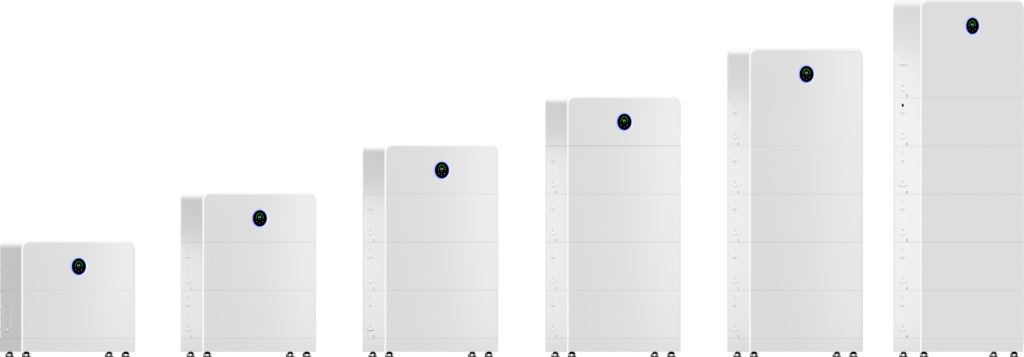
The stack builds from the floor up: a battery base, the modules, then the inverter on top. The base ships with the inverter. GoodWe’s datasheet allows up to six modules in a single column, and our packages stay within one column. GoodWe’s Australian manual for the three-phase ESA adds detail on how a stack can stand:
- On the floor, away from a wall: up to four modules.
- On the floor, against a wall: up to six, with the anti-tip bracket fixed to the wall.
- On the wall: 8.3 kWh modules hang on brackets in groups of no more than two, up to six in total.
- Lifting: above three modules, the installer must use lifting equipment.
Because the modules stack upward, the footprint stays 800 mm wide and about 270 mm deep whatever the capacity; what changes is the height and the weight on the floor. Our GoodWe ESA installation guide covers space and siting.
Stack sizes: 16 to 48 kWh
Each module adds 8.0 kWh of usable storage. Rated capacity and weight below are our arithmetic from GoodWe’s per-module figures; the weights are for the modules alone, and the inverter adds 26 kg on single phase or 34 kg on three phase.
| Modules | Usable | Rated | Weight of modules | Our ESA packages |
|---|---|---|---|---|
| 2 | 16 kWh | 16.64 kWh | About 158 kg | 9.99 kW single phase |
| 3 | 24 kWh | 24.96 kWh | About 237 kg | 9.99 kW single or three phase |
| 4 | 32 kWh | 33.28 kWh | About 316 kg | 9.99 kW single or three phase; 15 kW three phase |
| 5 | 40 kWh | 41.60 kWh | About 395 kg | 9.99 kW single or three phase; 15 kW three phase |
| 6 | 48 kWh | 49.92 kWh | About 474 kg | 9.99 kW single or three phase; 15 kW three phase |
The 8 kWh steps make it easier to land close to your evening and overnight use instead of rounding up a long way. On single phase, examples run from the 9.99 kW single-phase system with 16 kWh through the 9.99 kW single-phase system with 24 kWh and the 9.99 kW single-phase system with 32 kWh to the 9.99 kW single-phase system with 48 kWh. Three-phase sizes are covered in our guide to the GoodWe ESA three-phase models.
How many modules do you need?
Size the stack on how much electricity you use after the sun goes down, not on the biggest number that fits. Our guide to how to size a home battery works through it, and Build Your System suggests a size from your quarterly bill.
Two things the module count doesn’t change. First, in our packages the inverter sets the power limit: 13.5 kW charging and 11.0 kW discharging on the single-phase 9.999 kW model, 10.0 and 11.0 kW on the three-phase 9.999 kW model, and 15.0 and 16.5 kW on the 15 kW model. Adding modules adds storage, so the battery runs longer at a given load. Second, the federal Cheaper Home Batteries discount is calculated on usable capacity, so it counts 8.0 kWh per module rather than 8.32, and since 1 May 2026 it has been tiered, so it doesn’t grow in step with the stack. Our federal battery rebate guide has the current rate, and we explain why a bigger battery doesn’t mean a bigger rebate.
Frequently asked questions
How much usable energy does a GoodWe 8.3 kWh battery module store?
Each GW8.3-BAT-D-G21 module stores 8.0 kWh usable out of 8.32 kWh rated. GoodWe measured the usable figure at 96% depth of discharge, 25 °C and a gentle charge rate. Two modules give 16 kWh usable and six give 48 kWh, the largest stack in our ESA packages.
What is the difference between the GoodWe G20 and G21 battery modules?
Cold-weather charging. The G20 has integrated heating and can charge from −18 °C; the G21 charges from +2 °C. Capacity, size and weight are the same, and both discharge down to −20 °C. GoodWe’s manual says mixing G20 and G21 modules in one system makes the heating unavailable. Our packages use the G21.
How many GoodWe battery modules can be stacked?
GoodWe’s datasheet allows up to six modules in a single column under the inverter. Its three-phase manual allows up to four when the stack stands on the floor away from a wall, and up to six against a wall with the anti-tip bracket fixed. Our packages use two to six modules, or 16 to 48 kWh usable.
Can I add GoodWe battery modules later?
GoodWe says the ESA can mix modules of different capacities and ages, so a stack can grow, up to six modules in a column. Plan it with us rather than assuming it: mixing G20 and G21 modules makes the heating unavailable, the inverter’s power limits stay the same, and the federal discount rules for added capacity are worth checking before you buy a smaller stack.
How long does a GoodWe battery module last?
GoodWe tests the module to at least 8,000 cycles under laboratory conditions, which is a durability figure rather than a guarantee. The guarantee is the warranty: 10 years, with the battery keeping at least 70% of its usable energy over that time or until a set energy throughput, whichever comes first. Our home battery warranty guide compares the terms.
Sources: GoodWe ESA single-phase and battery module datasheet (AU) · GoodWe ESA three-phase and battery module datasheet (AU) · GoodWe ESA three-phase user manual (AU, V1.0, January 2026) · GoodWe Australia — ESA series product page · GoodWe limited warranty for the ESA (AU/NZ) · Clean Energy Council — approved batteries · WhySolar — CEC listing dates for GoodWe battery modules (secondary) · Clean Energy Regulator — Cheaper Home Batteries Program
Every figure on this page is checked against its primary source before publication. If a datasheet, warranty or program rule changes, this page is updated and the verification date above moves with it.
Find the stack size that fits your evenings
Build Your System asks about your existing solar, your phase, your quarterly bill and your backup needs, then recommends a system with a smaller and a larger option beside it, with indicative pricing.